Thursday, January 26, 2023

Against the Grain: Captain Thomas Masterson and the Fourteenth Amendment

This article is part of the 52 Ancestor Challenge. Each week in 2023, I will attempt to spotlight one ancestor from my family tree and provide some details about his or her life.

Week Three


Against the Grain: Captain Thomas Masterson and the Fourteenth Amendment
By Clint Alley


A Cabin in the Woods

I went on a pilgrimage once.

Okay, it wasn't a real pilgrimage. 

A real pilgrimage is when you travel to a holy place for a spiritual purpose, like to pray at a holy shrine, to visit a holy relic, or to stay in a holy city. Some go on pilgrimages to achieve a higher knowledge of God or of themselves.

On this particular trip, I wasn't in search of anything divine. 

I went to Moulton, Alabama to look for an abandoned log cabin.
Me at the Masterson UDC Cabin
April 2014


The cabin was not holy, but it did have a great deal of significance to me. And the journey was not inspired, but I did learn a little bit about myself along the way.

The cabin in question is nearly a century old, and it was built in memory off my great-great-great-great grandfather, Captain Thomas Masterson. After I learned about its existence, I made plans to find it. 

The journey introduced me to a part of my family's story that I didn't expect to find. In a small and unexpected way, at a precise moment in time, my ancestor played a part in moving the United States one step closer to living out its creed, that all men are created equal.

To me, that made the cabin worth searching for.

An Unlikely Radical

Captain Thomas Masterson was born on March 20, 1820, in Lawrence County, Alabama. His father, Thomas Masterson, Sr. (1779-1867) was an early settler of that area. Later accounts would postulate that Captain Tom's older brother, Robert M. Masterson, was the first white child born in Lawrence County, Alabama.

Captain Tom married Amanda Finney on December 16, 1841. He became a lawyer, a politician, a court official, and an active member of county life. He owned a mill and got press in the local newspaper at least once for growing impressively large sweet potatoes. But before that, he was an officer in the local militia company during the Civil War. And before that, he was a farmer who kept a general store. And, like many men of his time, he owned enslaved people.

Thomas Masterson
1860 Slave Schedule
Source: Ancestry
In 1860, Captain Tom held four people in bondage. The 1860 slave schedule does not record the names of these men and women, but it does tell us their sex, age, and race. In the order they are listed, they were a 40-year-old black male, a 32-year-old black female, an 8-year-old black male, and a 30-year-old black male. 

Most slave schedules listed enslaved people strictly in descending order by age, which makes the inclusion of a 30-year-old male after an eight-year-old boy an unusual anomaly.  This unusual grouping leads me to believe that the first male, female, and young boy were possibly a mother, father, and child, although I can't say for sure. One day I hope to track down as many of the names as possible of the people my ancestors held in slavery, so that they can be given their rightful spot in my family story, but that work has not yet begun.

Captain Tom was certainly not the only person participating in the sin of slavery in that time or that place. The men and women he enslaved in 1860 were four of the 6,788 people held in bondage in Lawrence County, Alabama that year. It was a common sin, but a sin nonetheless, and Captain Tom was guilty of it.

Which is what made the path he chose after the guns went silent five years later all the more surprising.

Citizen Soldier

Of all of my ancestors who served in the American Civil War, Captain Tom's military service has been the hardest for me to prove with contemporary evidence (records which were made at the time of his service.) I also have no record written in his own voice. Everything I know about Captain Tom comes from things that were written about him, not by him. If any of my conclusions in this article come across as assumptions, the fault is entirely my own. 

Unlike most Civil War soldiers, Captain Tom has no compiled military service record at the National Archives. He never applied for a pension for his service. Inquiries to the Alabama Archives for cursory index searches have failed to find anything. In fact, every source I have found of Captain Tom's service comes mostly from newspaper articles, printed years after the war ended, supplied to editors by Captain Tom's descendants.

Every source, that is, except one.

In his lifetime, Captain Tom was regularly referred to by his rank in local newspaper records. In fact, he is almost consistently called "Captain Tom," "Captain Masterson," or "Captain Thomas Masterson" whenever local newspapers wrote a story about him. In those days, it was common for officers to retain their rank as a title after being discharged from service. 
The first mention of Captain Tom as "Captain"
in a local newspaper.
Source:
The Christian Herald (Moulton, AL),
29 Sep 1865, p. 3.


Beyond this, there are two likely reasons why I have yet to find any accounts of his service contemporary to the Civil War: the first is that he served in the Alabama Militia instead of the regular Confederate army, and the second is that I live very far away from Montgomery, Alabama, where the records of his service might be waiting in a roll of microfilm or scrap of paper that has yet to be digitized.

What the Record Shows

Aside from being called "Captain" for the last three decades of his life, the earliest record I have of Captain Tom's Civil War service is his obituary. Published in the Moulton Advertiser in January 1901, it says "he raised a company during the war, and in many fights with the enemy he displayed good generalship and great pluck and bravery."

In 1928, the Advertiser published the following article:

THOMAS MASTERSON APPOINTED LIEUTENANT IN 1863

While looking thru some old papers Tuesday Miss Ella Masterson and Mr. Tom Griffin found the following appointment made by Capt. D.C. White in 1863. It is understood that Mr. Masterson was made captain before the close of the war between the states:

Moulton, Ala., July 15, 1863

Thomas Masterson is hereby appointed 3rd Lieutenant in Company C, 4th Brigade 10th Division Alabama Militia. He will be respected and obeyed as such by all persons attached to said command. 

D.C. WHITE Capt. Co. 6

Approved by C.B. Robertson, Lieutenant Col., Company 6 Regular Alabama Militia
The enigmatic
commission.

Source:
The Moulton Advertiser 
6 Sep 1928
For several reasons, this is one of the most baffling and intriguing genealogical documents I have ever found. First, the "Company 6" designations in the last two lines are probably transcription errors. Company designations were always alphabetical. A likely explanation is that D.C. White was the Captain of Company C (misread as "6"), and the last line probably said something to the effect of "Approved by C.B. Robertson, Lieutenant Col., commanding [regimental number unknown] Regiment Alabama Militia. 

Also, if the obituary was correct in its assumption that Captain Tom "raised a company," why was he being commissioned 3rd Lieutenant instead of Captain? 

D.C. White (short for Dewitt Clinton White) was a longtime newspaper editor in Moulton. He also served for a year as a 2nd Sergeant in the 16th Alabama Infantry before hiring a substitute and securing a discharge from the infantry. His obituary says that White 
...served in the Confederate Army as a member of Company F, Sixteenth Alabama Infantry regiment, until 1863 when commissioned by Gov. Watts to raise a battalion in Lowndes County. He raised nine companies, but the war ended before they got into action.

C.B. Robertson, the commanding officer who signed off on the commission, was, indeed a lieutenant colonel in the Alabama militia. Robertson was elected to that post in Lowndes County, Alabama in May 1862, as evidenced by a letter to the governor of Alabama, currently in the state archives, certifying his election. 

What's more, the 4th Brigade, 10th Division Alabama Militia was present in the area of Moulton in the summer of 1863. On June 30, 1863, Brigadier General James H. Tompkins wrote a letter from Russellville to the adjutant general of Alabama that the brigade's official rendezvous point was Russellville, about 30 miles from Moulton.

The letter which proved the
presence of Captain Tom's division
in the vicinity in 1863.
Source: Alabama Department
of Archives and History
The pieces are all there. And even if it isn't a smoking gun, based on these points of corroboration, I am inclined to believe that the commission which Captain Tom's descendants brought to the office of the Moulton Advertiser that summer day in 1928 was probably a genuine record of his wartime service. 

From Rebel to Republican

At war's end, Captain Tom got busy. And he got political.

He started by taking an Oath of Allegiance to the Union. 

The Oath was part of the Ten Percent Plan first proposed by Abraham Lincoln and then adopted by Andrew Johnson. It said that if ten percent of voters in each of the former Confederate States swore an oath of allegiance to the Union, that state could write a new state constitution and form a new government. 

This plan fell apart completely in December 1865, when the southern states' delegates to Congress included a large number of unrepentant former Confederate officers and Confederate government officials, including the former vice president of the Confederacy. Radicals in Congress were outraged, and refused to seat the southern delegates--many of whom had borne arms against the U.S. government just months before--beginning the first phase of Congressional Reconstruction, a program of rebuilding the South which was designed by Republicans in Congress to reshape southern culture as well as punish former Confederates.

In 1931, the Moulton Advertiser reproduced an oath of allegiance reportedly taken by Captain Tom. The old document, which was owned by one of Tom's grandsons, was endorsed by Probate Judge Charles Gibson on August 30, 1865. 

Also, on September 29, 1865, the Moulton Christian Herald reported that "Captain Thomas Masterson has been appointed General Administrator for Lawrence County." 

The office of General Administrator in Alabama is appointed by the Probate Judge, and oversees the estates of deceased people for whom there is no other administrator to be found. No doubt Captain Tom was appointed to this post by the same Judge Gibson who gave him the oath of allegiance the previous month.

Judge Gibson, who was first elected as Probate Judge for Lawrence County in 1858, is said to have spent the war years laboring tirelessly to ensure that the wives and children of Confederate soldiers were provided-for, even going so far as to pay for food out of his own pocket. He was re-elected in 1864, but was disenfranchised by Alabama's Reconstruction government in 1866. 

So you can imagine my surprise when I learned that Captain Tom--this respected, seemingly conservative, ex-slave owning, former Confederate soldier who was appointed to county office by a pro-Confederate judge--ran for the state legislature as a radical Republican.

Captain Tom in the Party of Lincoln

A word about Reconstruction political parties. Today, the Republican Party is the nation's conservative party, and the Democratic Party is the nation's liberal party. During Reconstruction and for a century afterward, those roles were generally reversed. The Democratic Party of those days generally captured the nation's conservative impulse while the early Republican Party was one of the most liberal movements our nation has ever seen. For simplicity's sake, when I describe Captain Tom's politics during this period, I am describing what appears to be a moderately conservative man becoming a liberal seemingly overnight.

On December 19, 1867, Captain Tom was nominated for the state legislature by the Republican Party of Lawrence County, Alabama. The resolution which announced his nomination also promised that Lawrence County Republicans would "adhere to and abide by the Republican Union platform, as adopted at the Montgomery convention in June last."

Assuming he was one of these men who pledged to adhere to that platform, what did that mean for Captain Tom?
The Republicans of 
Lawrence County, Alabama
nominated Captain Tom
for the legislature in 1867.
Source:
The Daily Sentinel,
27 Dec 1867.
Among other things, it meant that he endorsed "the action of Congress on the question of reconstruction" (meaning he supported the more punitive measures enacted toward the South by Congress after the Ten Percent Plan failed), that he would "endeavor to secure...the equal rights of all men and the full enjoyment of the rights of citizenship without distinction on account of color," that he supported "the removal of the tax on cotton and the state poll tax." 

Support for Congressional Reconstruction, equal citizenship for African-Americans, and the removal of the poll tax were extraordinarily liberal notions, indeed, at that place and time. It certainly stirred the ire of the man who may have been Captain Tom's commanding officer in 1863. 

D.C. White's conservative Moulton Advertiser hurled invective at the Republican platform in the summer of 1867, claiming that the entire Republican convention held at Montgomery was "begotten in fear and born in corruption," and that its parents were "Congressional oppression and lust for power."

I don't know what motivated Captain Tom's decision to join the Republican Party. It was a move with potentially seismic implications, to be sure. It earned him a brief mention in the book The Scalawag in Alabama Politics: 1865-1881, a work of scholarship concerning southerners who joined the Republican Party after the Civil War by Sarah Woolfolk Wiggins. 

However, this phase of Captain Tom's life, as unexpected as it might be, brought him what I consider to be one of the most enduring parts of his legacy.

The Fourteenth Amendment

Captain Tom was elected to represent Lawrence County in the Alabama legislature on February 4, 1868 and was sworn in as a member of the State House of Representatives of Alabama on July 13, 1868. In fact, Captain Tom was a member of the first group of Republicans to be elected to state office in Alabama history, and was part of one of the most racially diverse classes of legislatures the state has ever known. Later that day, he was one of 67 members of the State House who voted in favor of ratifying the Fourteenth Amendment to the Constitution, fulfilling his local party's pledge to support equal citizenship and helping Alabama cross a major checkpoint on its way toward being readmitted to the Union.

The Fourteenth Amendment defines the criteria for citizenship and, most importantly, guarantees equal protection under the law for every citizen. It extended citizenship to every person who was "born or naturalized" in the United States, regardless of color.
The record of the Alabama House of Representatives
showing the results of the vote to adopt the 
Fourteenth Amendment.
Captain Tom's name is highlighted.
Source: Alabama Department of Archives and History

The Fourteenth Amendment was the subject of Amend: The Fight for America, a popular six-part Netflix series hosted by Will Smith in 2021. 

Simply put, the Fourteenth Amendment remains one of the most important pieces of civil rights legislation in American history. It defended the formerly enslaved as full-fledged citizens with every right due to citizens, and ensured that everyone enjoyed equal protection of the laws. It is one of the most-often cited amendments in litigation today, and has been crucial to many of our most important Supreme Court opinions. 

As you might remember from history class, amendments to the Constitution must be ratified by three-fourths of the state legislatures in order to take effect. Captain Tom was there at just the right time to take part in the historic moment for Alabama.

Alabama's ratification of the Fourteenth Amendment came just days after South Carolina gave the amendment the numerical green light it needed to become part of the Constitution. And, under a law passed by Congress earlier that year, Alabama was required to ratify the Fourteenth Amendment before it could be readmitted to the Union. No ratification meant no representation in Congress. Alabama's hands were effectively tied. 

But still, I think it's pretty cool that my ancestor Captain Tom voted in favor of it on his first day in office. Four representatives voted against ratification. Captain Tom could have been the fifth, but instead he voted yes. And, although we may never know what he was thinking when he cast that vote, the fact that a man who once owned slaves could vote in favor of legislation that made those former slaves politically equal to him seems to me to be a moment of personal growth, even if it may have been done out of political necessity.

The End of an Era

Captain Tom's career as a liberal politician didn't last long.

He was an active member of the legislature, present throughout most of the sessions during that first two-year term of office.

On July 30, Captain Tom introduced a bill which would have "fully restored" the right to vote to several groups of people disenfranchised by the Alabama Constitution of 1867, including former Confederate soldiers, the insane, and certain criminals. The act was tabled.
Captain Tom's radicalism had moderated
sufficiently by December 1868 for the
conservative 
Moulton Advertiser to refer to 
the Republican as "our amiable and
indefatigable Representative."
Source:
Moulton Advertiser, 25 Dec 1868, p. 2.

The zenith (or nadir, depending on how you look at it) of his radical summer came when he began making stump speeches in favor of former Union general Ulysses Grant for president. Journalists from as far afield as the New York Herald pointed to Captain Tom as one of the "great men of the carpet-bag regime" in Alabama and a "leading light" of the Alabama radicals. 

By late summer, however, the tide began to turn. For reasons not reported in any newspaper, Captain Tom moderated his politics, abandoned Grant, and, according to the New York Herald, began to throw his support behind the Democratic candidate for president. Although he continued to be a Republican, Captain Tom's moderation became a hallmark of his political style. Years later, the Moulton Advertiser printed a letter in which a man was said to have voted the straight Republican ticket his whole life, except for Captain Tom, whom he "scratched on account of...not being extreme enough."

Captain Tom continued to be active in local politics, even attending the 1876 Republican National Convention in Cincinnati, Ohio as a delegate for Alabama. 

The Cabin

The remains of the
Masterson Mill
in 2015
At home, Captain Tom settled into his work as an attorney. He also built a gristmill at the confluence of Eddy and Turkey Creeks northeast of Moulton, parts of which are still standing (the spot where Highway 33 crosses that body of water has a sign labeling it 'Masterson Mill Pond' to this day). He continued with his duties as County Administrator. And he raised his family. When he died of kidney failure in 1901 at the age of 82, Captain Tom had several children and grandchildren.

His daughter Ella Masterson became extremely involved in the local chapter of the United Daughters of the Confederacy in the early years of the twentieth century. Everywhere a document connected to Captain Tom's wartime activities was reproduced in a local paper, she was there.

In 1934, she donated a cabin on a plot of land once owned by Captain Tom to the Wheeler Chapter UDC in Moulton.

The cabin was dedicated in a ceremony on May 10, 1934. At that time, the cabin was three miles from Moulton at "the Masterson homestead on the Courtland highway." The cabin was near the old Masterson Millpond. More than a hundred people came to the dedication ceremony, including at least one Confederate veteran. Dixie was sung, speeches were made, and one tribute was given specifically about Captain Tom which unfortunately I have not been able to find in print. 
The bridge over Masterson Mill Pond in 2015

The cabin was neglected during World War II, but repaired in 1949 and placed back into regular use. The UDC continued to meet there, but so did the local Cub Scouts and eventually the local Sons of Confederate Veterans camp.

In 1977, the land on which the cabin was built was condemned in order to straighten a curve in the nearby highway. With what must have been a great deal of hard work and effort, the cabin was removed from its original site and placed in its current location inside the city limits of Moulton in 1983.

Finding the Cabin

I went in search of the cabin in 2014. I began by asking my friends from college who were from Moulton if they had ever heard of it. Some of them vaguely remembered a grandma or a great-aunt talking about a cabin once, but no one knew where it was.

After some digging in UDC history books and old newspaper articles, I consulted the ladies of the Lawrence County Archives in Moulton. They were able to give me a vicinity where it was, but they warned me that it was probably overgrown and might be full of snakes.

A true Indiana Jones adventure, snakes and all!

After a few wrong turns and a consultation with Google Maps satellite view, I saw the woods where it had to be: a rugged patch of land behind the county high school, near the edge of town. 

At long last I found it.

The cabin was still there, tucked beneath a copse of trees and suffering from neglect. And, as luck would have it, it was not locked. In fact, I believe the door may have been ajar. The dedication engraved in the stone mantle told me I was in the right place. It said, "In memory of my father Capt. Thomas Masterson. Ella Masterson."

The cabin was a mess. Logs were damaged, furniture was scattered everywhere, and no doubt a few snakes had called it home over the years. But the building was still there. And I couldn't help but feel a connection with my long-dead ancestor as I stood in the quiet of that place, reading his name on the mantle with the cool spring breeze blowing through the holes in the wall. 

Captain Tom was a complex man. He was a patriot who answered when his state called during the Civil War. He was a public servant who quietly lent his voice to the chorus of Americans who demanded that we live up to our national creed in the years after that war. And he was a beloved man whose children and grandchildren continued to recall his deeds many years after he died and of whom even his opponents spoke well. 

I thought of all of this while I stood in that cabin, and I took a moment to remember Captain Tom. 

It was worth the journey.

A photo collage I made the day I visited the Masterson cabin in 2014. The bottom photo is of LaGrange Mountain, which is in a different county.


Works Cited

'Congressional Legislature.' The Times and Messenger (Selma, AL). 30 Jul 1868, p. 4.

'Demoralization of Southern Radicals.' The New York Herald (New York, NY). 23 Aug 1868, p. 4.

'Interesting Old Document.' The Moulton Advertiser (Moulton, AL). 3 Sep 1931, p. 1.

Irwin, Elizabeth Griffin. The Masterson Family, House, and Cemetery. The Moulton Advertiser. Moulton, Alabama. 11 June 1959, p. 7.

Journal of the House of Representatives, During the Session Commencing in July, September, and November, 1868, Held in the City of Montgomery. Jno. G. Stokes & Co., State Printers. (Montgomery, AL), pp. 9-10.

'Night Dispatches.' The Times and Messenger (Selma, AL). 22 Aug 1868, p. 3.

'UDC Meets at Cabin.' The Decatur Daily (Decatur, AL). 17 Oct 1949, p. 6.

'Republicans of Lawrence County.' The Daily State Sentinel (Montgomery, AL). 22 Dec 1867, p. 2.

Simms, Sadie. 'Moulton--Wheeler Chapter No. 2040.' History of the Alabama Division United Daughters of the Confederacy, Vol. III, Virginia James Cook, ed. The Strode Publishers (Huntsville, AL), p. 318.

US Census Bureau. “1860 Census: Population of the United States.” Census.gov, December 16, 2021. https://www.census.gov/library/publications/1864/dec/1860a.html. 

Saturday, January 14, 2023

Kind and Generous: The Christian Legacy of Sarah Harrison Kerr

This article is part of the 52 Ancestor Challenge. Each week in 2023, I will attempt to spotlight one ancestor from my family tree and provide some details about his or her life.

Week Two

Kind and Generous: The Christian Legacy of Sarah Harrison Kerr
By Clint Alley

The Surprise

The week before my wedding I made a remarkable discovery.

My wife and I could think of no better way to symbolize the seriousness of our commitment than by signing our names to the 'Marriages' page of one of our oldest and most treasured family Bibles. It fit in so many ways; the solemnity of our promise before God by incorporating His Word, the permanence of our commitment in the pages of a treasured family relic, and the added bonus of incorporating my love of genealogy in the ceremony.

Aunt Sadie Foster's Bible

My Grandmother allowed us to use the Bible of my great-grandaunt, Sadie Kerr Foster in our wedding ceremony. Sadie Kerr Foster, born in 1869, was my great-grandfather Harvey Kerr's sister. She lived a remarkable life; traveling from place to place and living in great hotels. Although she had no children of her own and died a widow, she shared her wisdom and love with her nieces and nephews in hundreds of letters, many of which still exist today.

Sadie Kerr Foster
From the collection of
Melanie Buffaloe Ginn

When she died, my grandfather inherited a trunk of her belongings, including her well-worn Bible.

In the center of the Bible, Aunt Sadie had fastidiously recorded the birth, marriage, and death dates of her parents, herself, and some of her siblings. On our wedding day, Christy and I added our signatures to this page.

As we prepared for the big day, I decided to leaf through the pages to ensure that nothing lay tucked there which might come loose during the ceremony. 

I am very glad that I did.

There, between the pages of the Bible, was a tiny, faded scrap of paper that was more than 130 years old; a one-of-a-kind relic of my family history.

It was the missing obituary of my great-great grandmother, Sarah Harrison Kerr. An obituary that--thanks to the unavailability of local newspaper records from the year of her death--probably exists in no other form anywhere on earth, and which offers one of the only surviving glimpses of who she was; a virtuous woman whose life was cut short far before her time.

Obituary of Sarah Harrison Kerr
Found in the pages of Sadie Kerr Foster's Bible


The Fountain which Never Runs Dry

Sarah Elizabeth Harrison was born on May 13, 1839 in Buckingham County, Virginia. She was the daughter of Benjamin Harrison (1805-1885) and Mary Beth Vawter (1808-1877). Sarah and her family moved to Columbia, Tennessee in 1846, when Sarah was seven years old.

Sarah's obituary records that "at the tender age of 12 she gave her heart to the Savior, and shortly thereafter united herself with the Baptist church, of which she has been a devoted, consistent member; and exhibited throughout her entire life that confidence and trust in Jesus, which is characteristic of a pure Christian." 

Not only did Sarah unite with the Baptist church; she--along with her father and sister--became one of thirteen original members of First Baptist Church of Columbia. The church was founded in 1856, some five years after Sarah's conversion. 

A 1908 obituary for Sarah's older sister Emma Harrison Sheppard published in the Baptist and Reflector says that Emma came to faith in Christ at "the memorable Philips Neely revival in the [Methodist] church" in about 1849, but joined the Baptist church along with Sarah and their father in 1856. Sarah's faith journey probably took a similar--if not identical--course. 

We can't be sure if Rev. Neely was the one who lead Sarah to faith also. But we do know the content of some of Rev. Neely's sermons, thanks to his wife's timely publication of them shortly after his death. One, in particular, was designed to get the attention of young people like Sarah and Emma. In his sermon The Need of Religion, Rev. Neely said, 

O that I could persuade you to draw your happiness in the morning of life from that fountain which never runs dry! O that I could influence you to put away that infatuation which tells you to postpone your return to God until your earthly hopes are dead, and age, with its infirmities, is upon you!

Down to the River to Pray

That same Baptist and Reflector obituary records that Sarah and Emma "were baptized by Dr. J.R. Graves in Duck river in the presence of a large assemblage of people." 

An article from the Tennessee Baptist describing 
the baptismal service where 
Sarah and Emma Harrison were baptized
on July 13, 1856

Dr. J.R. Graves was a prolific Baptist preacher who lived in Nashville. He published various Baptist newspapers from 1855 until his death. He also became a close friend of Sarah's father, Benjamin Harrison, by virtue of being part of the constituting committee of First Baptist Columbia. 

The Tennessee Baptist, Dr. Graves's paper published in Nashville, reported that an initial worship gathering was held in Columbia on June 29, 1856, at which time four pastors "constituted ten brethren and sisters into [a Baptist church]...at night one more was received by letter, and two have already offered themselves for baptism." 

The baptisms were held on July 13, and two men were also ordained as the church's first deacons that day. Those two candidates for baptism were undoubtedly Sarah and Emma Harrison, and one of the men slated for ordination was their father Benjamin Harrison.

A later Tennessee Baptist article describes that first baptismal service as "largely attended" and "solemnly impressive," with many present who had "never before witnessed...Christian baptism."

Sarah's baptism in the Duck River on July 13, 1856, was part of the 'grand opening' of First Baptist. Emma would be the last of the church's charter members to pass away, and every obituary for her intimately connected the Harrison family to the life of First Baptist Columbia. The church would remain a vital part of Sarah's life--and of the lives of her immediate family--until their dying days. 

Dr. J.R. Graves
The minister who baptized Sarah Harrison Kerr
Source: Wikimedia Commons

Answered Prayers

Despite the fervent prayers of its founders, the first decades of FBC Columbia were rocky. According to an article by Mrs. Robert Young in the book Churches of Maury County, Tennessee Prior to 1860, Baptists had been attempting with little success to form a church in Columbia since 1838. The formal chartering of First Baptist Columbia in 1856 was a major milestone, but many lean years lay ahead for the congregation.

The Civil War, which began five years later, scattered the church's members. The library and furniture which had been accumulated by the members was destroyed during the course of the war, and at war's end, little progress had been made in finding a place to build a home for the little congregation. 

In 1870, the church purchased a lot at the intersection of High and Mechanic Streets for $900 and "a faithful few" labored to pay for it over the next five years. 

Finally, in the summer of 1872, the church was reorganized and began holding regular Sunday services in a rented room above the offices of the Maury Democrat. The church's first building was completed and dedicated in the summer of 1876, two decades after Sarah and her family had helped to found the church. Judge W.B. Turner later wrote that the dedication of the church "was a joyful occasion for all and especially for Deacon Benjamin Harrison who had prayed earnestly for years that the Lord would let him live to see a Baptist church in Columbia."

Marrying a Presbyterian

In November 1858, when Sarah was nineteen, she married a cabinet maker named Andrew Harvey Kerr. The ceremony was conducted by Rev. George W. Griffin, the first pastor of First Baptist Church.  Andrew--or Harvey, as he was known, and as one of his sons would be named--came from a long line of Scottish Presbyterians. His grandfather, it was said, was a zealous Presbyterian who would "sing, pray, and exhort at the meeting" and "sing and shout in the field while following his plow." Andrew Harvey's father and many of his close relatives were listed among the members of Port Royal Presbyterian Church in Spring Hill, Tennessee in the 1870s and 1880s.

Although the details of Andrew Harvey's personal religious convictions are lost to time, we catch a glimpse that he probably shared the Presbyterian faith of his forbears from his obituary, which says that his funeral was held at Columbia's Presbyterian Tabernacle, albeit presided over by a Baptist minister.

The faith of their children might also give some evidence of the faith journey Andrew Harvey made in life. His son Harvey James Kerr (my great-grandfather) was a committed member of the Church of Christ, a movement which drew in many conservative Presbyterians in the late 19th century. On the other hand Sadie, the owner of the family Bible I mentioned above, once subtly ribbed her brother Harvey in a letter about his faith of choice. Sadie, like her mother Sarah, was a committed Baptist. In 1952, while congratulating Harvey on his son's wedding, Sadie said, "Mack wrote me that a Baptist minister is performing the ceremony (that pleases me!!)." 

Part of a letter from Sadie Kerr Foster to her brother Harvey James Kerr
(Both were children of Sarah Harrison Kerr)
March 10, 1952
Collection of Clint Alley
A Fireside Missionary

Sarah Harrison Kerr not only played an active role in the formative years of First Baptist Church Columbia, she also conducted a campaign of evangelism around her own hearth. Her obituary says, "Her many noble Christian virtues were daily displayed in her home around her fireside, where she instructed her children so faithfully, in tenderness teaching them the way of truth and righteousness."

What beloved passages might she have read to her children around that fireside? Her daughter Sadie was prone to mailing Bible verses to her nieces and nephews to memorize for Sunday School in her later years. Might this have been a practice she learned at the knee of her precious mother?

Sarah's Christian influence extended well beyond her years, and continued to inspire her descendants for decades after her passing. Although our window into Sarah's life is small, we see a woman who lived in extraordinarily challenging times and whose whose life was powered by extraordinary faith. 

The Civil War no doubt tested Sarah's endurance as well as her faith. In addition to being pregnant for most of 1862 (their second son, who was born that year, was named Robert Lee Kerr), Sarah suffered the hardship of keeping the household functioning without her husband for months at a time. The Civil War took Andrew Harvey from home at least twice; once at the beginning, when he enlisted in the Second Tennessee Infantry, and again at the end of the war, when Hood was making his final push toward Nashville. 

As the Confederate army swept through Columbia in November 1864, Andrew Harvey was conscripted into the Third Tennessee Infantry, and served a little less than a month for the Battles of Franklin and Nashville before returning home. In his oath of allegiance to the Union, made in January 1865, he said that he left the Confederate army because he "has a family."

Sarah's brothers also served in the Confederate army; one as a surgeon and one as an infantryman who walked home from Ohio after spending part of the war in a Union prison camp.

By the mid-1870s, Sarah, Andrew Harvey and their family were living near Dark's Mill, a community along the banks of Carter's Creek about seven or eight miles north of Columbia. In a twist of fate, their home was very near the home of Hamlin Alley, my 4x-great-grandfather on my father's side. Hamlin had moved his family to Maury County from Lawrence County after the Civil War.
The 1878 D.G. Beers Map of
Maury County
Homes of A.H. Kerr and
H. Alley highlighted in blue.
Source: Library of Congress


In 1877, the Columbia Herald and Mail reported "Mr. Harvey Kerr has a very sick family. His wife is very low; and his son Odie, who was accidentally shot Christmas, is improving very slowly." We don't know what ailment Sarah was suffering from in 1877. Perhaps it was the opening salvo of the disease which would cut her life short two years later. Whatever her ailment in the winter of 1877, she did not bounce back from it quickly; a blurb three weeks later said that she was still "improving slowly."

In September 1879, Sarah--mother of at least nine, the youngest of whom was four years old at the time--died of tuberculosis. She was only thirty-nine years old.

The Mission Continues

Sarah lived to see the first two decades of the Christian work she and twelve other believers began in Columbia. But the church she helped to found has blossomed into a major force for the Gospel. Untold thousands of souls have been impacted by First Baptist Columbia and the churches it has helped create. The Women's Missionary Union of Tennessee was created at FBC Columbia in 1888. By 1950, the church had more than 800 members. 

A photo I snapped of FBC Columbia in 2018.
Collection of Clint Alley

In 2001, First Baptist (now known as The First Family) moved from its downtown location to a 30-acre campus on Pulaski Highway south of Columbia, where expansion was easier. The church today has a staff of nine pastors, including a Hispanic ministry, and has sent many missionaries to the field worldwide. 

If Sarah could see the church today, and the many thousands of lives it has impacted since she first rose up from the waters of Duck River that Sunday so long ago, I think she would be immensely thankful. 


Works Cited

Churches of Maury County, Tennessee Prior to 1860. Columbia, TN: Tennessee Chapter, Daughters of the American Revolution, 1980.

'Dark's Mill Items,' Columbia Herald and Mail. 9 Feb 1877, p. 3.

'Death's Harvest.' The Herald and Mail. Columbia, Tennessee. 13 Nov 1908, p. 6.

“First Baptist Celebrates 160 Years of Serving Community.” The Daily Herald. The Daily Herald, August 8, 2016. https://www.columbiadailyherald.com/story/lifestyle/celebrations/2016/08/08/first-baptist-celebrates-160-years/25629174007/.

Foster, Sadie Kerr to Harvey J. Kerr, 10 Mar 1952, Collection of Clint Alley.

'In Memoriam: A Memorable Mother in Israel is Gone.' Baptist and Reflector. Nashville, Tennessee. 15 Oct 1908, p. 6.

McDaniel, Frank Kerr. Kerr Family History Project. Santa Clarita, CA: F. Kerr, 1993.

Neely, Philip Phillips. Sermons. United States: Southern Methodist Publishing House, 1884.

Tennessee Baptist. Nashville, Tennessee. Vol XII, no. 42. 28 Jun 1856, p. 3.

Tennessee Baptist. Nashville, Tennessee. Vol XII, no. 44. 12 Jul 1856, p. 3.

Tennessee Baptist. Nashville, Tennessee. Vol XII, no. 46. 26 Jul 1856, p. 3.

Turner, William Bruce. History of Maury County, Tennessee. Nashville, TN,: Parthenon Press, 1955.

Sunday, January 8, 2023

You Say You Want a Revolution: The Eight Tours of Duty of Shadrick Alley

This article is part of the 52 Ancestor Challenge. Each week in 2023, I will attempt to spotlight one ancestor from my family tree and provide some details about his or her life.

Week One

You Say You Want a Revolution: The Eight Tours of Duty of Shadrick Alley
By Clint Alley

Papa Was a Rolling Stone

In his application for a Revolutionary War pension, my 6x-great-grandfather Shadrick Alley said that he was "born and raised" in Brunswick County, Virginia. What little we know about the circumstances surrounding his birth comes from the vestry book which recorded his baptism (a book whose existence he actually made mention of in his pension application; when asked what proof he has of his age, he answers that his birth record is "in a church record near Petersburg"). He was christened into the Anglican Church in Bristol Parish, Virginia on May 12, 1751. His mother Winifred's name appears in the record. However, his father's name is conspicuously absent from the entry in this book.

Within two years, Winifred paid a fine of £2.10.0, presumably for giving birth to a child out of wedlock. Similar entries in the book indicate that £2.10.0 was a common bastardy fine amount paid by other women. Indeed, the fact that Shadrick carried his mother's last name has left the identity of Shadrick's father a mystery which is unlikely to ever be solved, although there is some speculation that his uncle Drury Alley may have known the identity of the father, as a later entry in the vestry book notes that, "Ordered That the Church Wardens Apply to Drury Alley for Winifred Alleys fine and on his Refuseing to bring Suit against him."

Entries in the vestry book show that Winifred's father Abraham Alley was still being paid for his services as sexton in 1753, indicating that he was still alive at the time of Shadrick's birth. 

By the eve of the American Revolution, Shadrick was about twenty-four years old, living among his kin in Brunswick County, near the northern border of North Carolina. Extant marriage records indicate that he was married to Mary Price in 1773. Family Bible records indicate that by the time he first went into militia service, he was the father of one child and Mary was probably beginning to show with their second.

A Rebel with a Cause

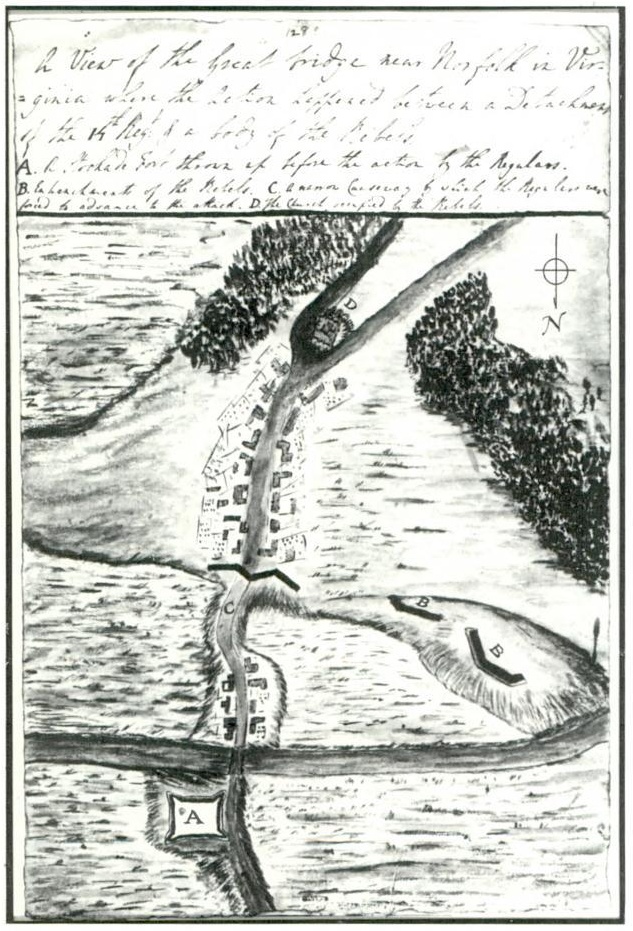
Shadrick served eight tours of duty as a patriot militiaman during the American Revolution, a period of time which totaled about about two years in active service. He probably first went into military service for the patriot cause in the fall of 1775. His pension application records that he was present at the Battle of Great Bridge, a lopsided Patriot victory near Norfolk, Virginia on December 9, 1775 (which Shadrick erroneously remembered as the "Battle of Long Bridge"). His second tour, which must have begun immediately following the first, was after the fight at Great Bridge, when Shadrick said that he was present at the burning of Norfolk, Virginia. The burning of Norfolk occurred during the first weeks of January 1776. 

Shadrick's third tour was a relatively uneventful march to Cabin Point, Virginia "in the Fall of 1777...where [the regiment] lay without anything material occurring." 

Battle of Great Bridge by Lord Rawdon
Drawing made shortly after the battle
Source: Wikimedia Commons

The Substitute

The fourth--and longest--tour was a six-month period in the fall and winter of 1778-79, when Shadrick served as a substitute for his uncle Miles Alley of Northampton County, North Carolina (Miles's birth is recorded in the same vestry book which records Shadrick's baptism, listing Miles's date of birth as May 18, 1741). During this period of American history, if a man's militia regiment were activated, and he was unable to serve, he was allowed to hire a substitute. Shadrick's pension application does not tell us why his uncle Miles Alley was unable to serve, but it was apparently a one-time deal. The North Carolina archives contains a pay voucher for a Miles Alley who did serve in the militia in 1782, indicating that either Miles or a relative by the same name did eventually render active service to the patriot cause. 

Shadrick fought in the "Briar Creek defeat" during this fourth tour. Fought on March 3, 1779 in Screven County, Georgia, the Battle of Brier Creek was, indeed, a defeat for patriot forces. The British, who had destroyed a bridge over Brier Creek, ambushed the patriot forces encamped along the banks while the patriots attempted to repair the same bridge. The patriots fled in a confused rout. Consequently, the British were able to maintain a foothold in Georgia and launch their subsequent invasion of South Carolina.

A Change of Scenery

Shadrick recalled in his pension application that, "after the battle [the regiment] returned to McAlpine's Creek in Mecklenburg County, North Carolina where the troops lay for some time, from thence went to Salisbury, N.C. where we were discharged." He returned to Virginia in 1779 and "removed my family from thence to Rutherford County, North Carolina." 

Was Shadrick seeking an escape from war in the back-country of North Carolina? For most of the first years of the war, North Carolina had remained quiet, with few battles or skirmishes compared to the action Shadrick had seen in Virginia. The constant disruption of short-term military service would have made it difficult to maintain the rhythms of daily agricultural life. While we may never know for sure, what we do know is that, after four years of intermittent fighting, Shadrick uprooted his young family and traveled nearly 300 miles west to the foothills of the Appalachian Mountains. 

If Shadrick hoped to escape the war by going toward the mountains, he suffered a rude awakening in the fall of 1780, when he was drafted into military service again for a fifth tour, this time for a four-month term which turned out to last only three months. The militia company in Rutherford County, Shadrick explained, "was called out for the protection of the frontier against the Cherokee Indians," and was "kept generally in motion."

The Cherokee nation allied with the British during the American Revolution. The British government made several treaties with Native American tribes across North America in hopes that the rebels would be forced to allocate much-needed manpower toward protecting their towns and villages along the Appalachians from Indian raids. The plan was ultimately not successful, and the Native Americans paid a much steeper price than the British did for its failure. Shadrick's presence "generally in motion" to respond to Cherokee raids along the southern frontier is proof that the young state governments had little problem deploying men along two fronts.

In 1781, Shadrick was drafted for a sixth tour of militia service, during which he fought at the Battle of Guilford Courthouse, North Carolina. On March 15, 1781, patriot forces under command of General Nathanael Greene attempted to stop the advance of the British commander Lord Cornwallis near what is today Greensboro in Guilford County, North Carolina. Although the British were left with possession of the field, Cornwallis lost around a quarter of his forces in the battle, forcing him to withdraw to his supply base at Wilmington and reevaluate his southern strategy.

Shadrick said in his pension application, "I knew General Green and other continental officers then, but whose names have now escaped my recollection." Did Shadrick know Nathanael Greene personally? Or did he mean that he simply knew who he was? This tantalizing clue has inspired me to one day conduct a more-thorough search in the papers of General Greene for any evidence that he corresponded with Shadrick.  

General Nathanel Greene
by Charles Wilson Peale
Source: National Parks Service

Going Home Again

Shadrick said that, after he returned from the Battle of Guilford Courthouse, he "removed back to Brunswick County in the state of Virginia." After little more than a year in North Carolina, with half of his time there spent serving in the militia, had Shadrick decided that he would be better off escaping the war by returning home? Or had his frequent absence made it impossible for his family to make a crop, forcing them to seek shelter with family back in Virginia? Shadrick doesn't say, but it's hard to imagine his young wife and small children (who, by 1781 included my 5x-great-grandfather Howell Lafayette Alley, who was born in 1779) successfully operating a farm so far from their extended family with the man of the house constantly away at war.  

As fate would have it, at about the time that Shadrick Alley decided to move his family back to Virginia, Lord Cornwallis also made the fateful decision to march into Virginia, ensuring that Shadrick's fighting days were not yet done. In fact, 1781 started out as one of the worst years of the Revolution for Virginia. In January, British soldiers commanded by the turncoat Benedict Arnold shattered patriot resistance and overran the state, culminating in Arnold's burning of Richmond. 

In June, the British raided Charlottesville with the aim of capturing Thomas Jefferson at his beloved Monticello. Jefferson escaped with only minutes to spare and spent the next few days on the run. It was probably at about this time that Shadrick, newly-arrived from North Carolina, was drafted back into active service. His militia unit spent three months at Petersburg, which was heavily occupied with patriot forces due to the presence of ammunition and supply stores there. In fact, it was the presence of so many militiamen like Shadrick that probably kept British raiding parties from looting the town and escaping with the vital military supplies needed to continue the fight.

Shadrick had returned to familiar territory at Petersburg. The vestry book he cited as proof of his age in his pension application was kept in Petersburg, probably at that time in the Old Blandford Church (known then as simply 'The Brick Church'), where his grandfather Abraham Alley was appointed sexton in 1742 and served for many years, and where Shadrick may have been baptized.

Old Blandford Church is still standing today, and it is near the top of my list of genealogical places to visit. 

Old Blandford Church in Petersburg, Virginia
Source: Library of Congress

Curtains for the Redcoats

Shadrick's eighth tour of duty began as the Continental Army--bolstered by French troops, French ships, and thousands of militia--encircled and trapped Lord Cornwallis in Yorktown, Virginia. Soon after Shadrick returned home from his time guarding Petersburg, he said, "After my return home I was again drafted for three months, in a company commanded by Captain Hartwell Raines, regiment commanded by Col. Bonner, and marched directly to York[town]." Shadrick arrived just in time to participate in the last great action of the Revolutionary War. As he said, he "was there at the surrender of Cornwallis." 

Lord Cornwallis's surrender to George Washington on October 19, 1781 was a monumental moment in American history. Cornwallis's defeat by the Franco-American force at Yorktown left most of America, with the exception of New York City, in the hands of the patriots. More importantly, it dealt a massive blow to British morale. Financially unable and unwilling to field yet another army in North America, the British government appealed for peace. The Treaty of Paris, signed two years later, recognized the independence of the United States and granted the new nation an extensive grant of land, setting its western boundary at the Mississippi River. 

According to his own statements, Shadrick was one of the soldiers in the field at Yorktown when Cornwallis surrendered. I certainly wish he had expounded on that moment a little. Did he see the redcoated officers surrendering their swords? Did he hear the British band playing The World Turned Upside Down? Did he celebrate with the French soldiers when the ceremonies ended? My ancestor was present at the British surrender and he paid for the birth of our republic with his blood, sweat, time, and toil. How I wish he had given the clerk just a couple of sentences about what he thought of that moment.

Beating the Sword into a Ploughshare

Shadrick's last tour, which was intended to be for three months, turned out to last only six weeks. After the British surrender, Shadrick made his way along the 125-mile path home to Brunswick County to resume a life which had so frequently been interrupted by war. 

Around 1785, Shadrick moved to North Carolina again, this time for good. Shadrick raised his family in central North Carolina, eventually settling in Iredell County around 1800. That final move from Virginia to North Carolina was eventful. When asked if he had a discharge paper to prove his service, Shadrick admitted to the clerk transcribing his pension application that he had probably been issued one, but that most of his personal papers had been "lost by the upsetting of my waggon [sic] in a river in North Carolina" during his final move from Virginia.

His neighbor and friend John Turbyfill had served with him during several of his tours of duty, and was the only eyewitness left living in 1832 who could vouch for Shadrick's service. The two men had been friends in Brunswick County as young men, and had moved to North Carolina around the same time. Their children and grandchildren most likely also intermarried, and Turbyfill is doubtless an ancestor of mine, as well. All I lack for proof is a document which I may never find.

Shadrick was an ordinary man who lived in exceptional times, and was allowed to witness some extraordinary historical events. According to a family Bible record which surfaced in Habersham County, Georgia sometime in the 20th century and which has the appearance of authenticity, he and Mary went on to have at least nine children. 

Habersham County, Georgia Bible Record
Source: Ancestry.com

Shadrick's pension application was approved, and he was allowed to draw until his death in 1835 at the age of 84. His passing warranted an obituary in the Raleigh Weekly Standard, which identified him simply as "a soldier of the Revolution."

Shadrick Alley's Obituary
The Weekly Standard (Raleigh, NC), p. 3.
29 May 1835


Works Cited

Alley, Shadrick Revolutionary War Pension Application [S6499]. NARA. Accessed 8 Jan 2023, Fold3.com. https://www.fold3.com/image/11127494?filmstrip=true&terms=alley,shadrick

“Died.” The Weekly Standard [Raleigh, NC]. May 29, 1835. p. 3.

“Guilford Courthouse.” American Battlefield Trust. Accessed January 8, 2023. https://www.battlefields.org/learn/revolutionary-war/battles/guilford-court-house.

Kranish, Michael. Flight from Monticello: Thomas Jefferson at War. Oxford University Press, 2011.

“The Vestry Book and Register of Bristol Parish, Virginia, 1720-1789.” Google Books. Priv. print. [by W.E. Jones]. Accessed January 8, 2023. https://books.google.com/books/about/The_Vestry_Book_and_Register_of_Bristol.html?id=b7GX427EbLAC.

Wednesday, July 8, 2020

The Shakedown: Davy Crockett Owed my Ancestor Money

Future-president James K. Polk got a lot of letters.

As his extant correspondence shows, he regularly heard from a number of citizens about a number of issues throughout the course of his public life. As a lawyer, he no doubt became used to the role of negotiator. And as a representative in Tennessee's General Assembly, he cut his teeth on the art of politics.

But as a member of Congress in 1828, Polk must have been surprised, indeed, when one concerned citizen asked him to become a debt collector and shake down a fellow congressman for an overdue debt.

On February 20, 1828, William Henry of Lawrence County, Tennessee mailed Polk a long-overdue promissory note from none other than the King of the Wild Frontier, himself, David Crockett. The letter that Henry sent with the note said the following:

Lawrenceburg Tennessee Feby 20th 1828
Sir I take the liberty of encloseing a note of hand on Colo
Crocket that I want you to colect for me as you are the Only 
member that I am acquainted with. You will please Direct your
letter to Lawrenceburg Tennessee.
WM. HENRY

William Henry's 1828 letter to James K. Polk
Library of Congress.


To which Polk added the following endorsement:

"The note above alluded to is for $12.75 dated l0th Oct. 1822, due one day after date,
payable to Moses Pennington. This day enclosed the said note to Wm. Henry,
Lawrence County Tennessee. March l0th 1828. J.K.P."

There is a lot to unpack here, so let's dive right in.

Moses Pennington was my 5x-great-uncle, a brother of my 5x-great-grandfather Isaac Pennington. We know a considerable amount about the Pennington family of Lawrence County, thanks to their early arrival in the area, their numerous children, their massive landholdings, their civic engagement, and the great sheaves of documentation generated by the disposal of their large estates.

According to Goodspeed's History of Tennessee--and supported by relevant documentation--the Penningtons were among Lawrence County's first white settlers shortly after the U.S. government paid the Chickasaw Indians around two cents an acre for the region in 1816. The four Pennington brothers, along with their father Jacob, owned thousands of acres of territory along the Buffalo River near the modern community of Henryville. Moses built the county's first watermill and distillery. 

Lawrence County's court records also indicate that Moses was no stranger to trouble with the law. In 1818, Isaac and Moses plead guilty to the charge of selling liquor without a license (the Dukes of Henryville?). No doubt these spirits were made at Moses's distillery. Moses was brought to court on another charge of bootlegging a year later, but contested it, and was found not guilty.

The record of Isaac and Moses Pennington's indictment for bootlegging.
Lawrence County, Tennessee Archives

The Penningtons were mostly literate, comparatively wealthy, and industrious, their harsh frontier environment notwithstanding.

When Isaac died many years later, his estate included promissory notes from dozens of local people. These notes were a normal part of everyday life for the period. With no banks in close proximity, notes supplied an easy way to keep track of indebtedness. Unfortunately, we have no such inventory for Moses Pennington's estate, but it would not have been out of character for a man of his means to hold several such notes. And so it is not surprising that, in the autumn of 1822, Moses loaned $12.75 to Lawrence County's most famous founding father, the one and only David Crockett.

David Crockett
It's also not surprising that Crockett was in need of funds at the time. In that season of his life, Crockett was habitually short on cash. A disastrous flood of Shoal Creek in September 1821 had destroyed Crockett's mill and distillery, and Crockett's operation had been built almost completely with borrowed money. With his industry destroyed and his prospects for commercial success dashed, Crockett's creditors had no choice but to take him to court to demand payment.

Facing dissolution, Crockett liquidated his landholdings in Lawrence County and moved west. And apparently--if Henry's letter to Polk is to be believed--he borrowed $12.75 from my 5x-great-uncle, Moses Pennington not long after.

Moses, himself, was dead by 1826. His estate was sold and the assets distributed by the fall of that year. If the debt was legitimate, the most likely scenario of how William Henry came to own Crockett's debt to Moses was that he bought it from Moses's estate. Apparently knowing no other way to exact payment for the debt, Henry sent the long-overdue note to Crockett's fellow-Congressman from Tennessee, James K. Polk.

The date of the note raises several questions.

Indeed, the date of the note is the only detail that casts its authenticity in a dubious light.

Was Crockett in Lawrence County in late October 1822, or perhaps was Moses for some reason in Carroll County? We know from extant court records that Crockett was physically present in his new Carroll County home by September 9, and that he was again physically present in Carroll County in early December of that year. Crockett was prone to go on long-range hunting trips in the fall, after his corn had been harvested, but it is doubtful that he would go back to Lawrence County for such a trip, when  by his own admission, "game was plenty of almost every kind" in his new West Tennessee home.

While the circumstances surrounding the date of the note do somewhat muddy the waters of this fascinating story, there is little doubt that Crockett and Pennington knew each other—court records indicate that Crockett was present as a Justice of the Peace during some of Moses’s court appearances—and there is little doubt that Moses could have loaned money during a period when Crockett desperately needed it.

It is interesting to note that Crockett’s autobiography names a "young man named Abram Henry" as one of his companions on his initial scouting trip to his new West Tennessee home.  Local lore also says that Henryville, the community where the Pennington family initially settled, was so-named because the first postmaster of the village was a man named Henry. No doubt there is something to all of these connections that adds a further thread of legitimacy to the 1828 letter.

Whether Polk exacted payment from Crockett or not is a mystery. But if you are a descendant of Crockett and would like to settle up (with 200 years of interest, of course), I accept PayPal.

Monday, May 27, 2019

Some Gave All: Reflections at the Grave of Private Throgmorton


I have one ancestor who died wearing the uniform. John C. Throgmorton was my 4x-great-grandfather. Although born and raised in Tennessee, he joined the Union army in 1863.

His son-in-law William Riley (my 3x-great-grandfather) had been serving in the Confederate army for two years when John enlisted, as had many of his friends and neighbors from northern Wayne County. There was a very real risk that the two could have faced each other on the battlefield. It makes you wonder what John’s daughter Rebecca—William’s wife of less than three years—thought of it all.

In the autumn of 1864, Throgmorton was captured by Confederate cavalrymen of Biffle’s regiment near Hampshire, Tennessee. In a twist of fate, another 3x-great-grandfather, Milas Glenn Alley, was serving with Biffle’s Regiment at the time of Throgmorton’s capture. Milas could have been present or even participated in the capture, and although the connection would have meant nothing to either man at the time, Milas’s yet-unborn son would marry Throgmorton’s similarly yet-unborn granddaughter some thirty years later.

Throgmorton spent the remainder of the war in the prison camp on the Cahaba River, near Selma, Alabama, where he contracted dysentery. When the war ended, he was sent first to Vicksburg, then on to Nashville, and was probably aboard one of the steam ships just ahead of the ill-fated ‘Sultana.’

Indeed, many years later, a rumor persisted among his descendants that he had perished aboard the ‘Sultana’ when that ship exploded on the Mississippi River, killing many of Throgmorton’s comrades.

He died of acute dysentery at Cumberland General Hospital Nashville in July 1865 and is buried in the Nashville National Military Cemetery.

John C. Throgmorton was 45 years old when he died. He left behind a widow and twelve children, seven of whom were under the age of 14. The youngest was barely 2 years old at the time of his death.

Visiting his grave a few years ago was an emotional moment. I don’t understand why he chose to wear the blue coat instead of the gray. But to know how his life ended, to see those hundreds of rows of clean white stones, and to know that the very DNA I carry in my body was absorbed from his blood and bone into the dirt beneath my feet more than a century before I was born left me feeling greatly humbled.

I respect the great sacrifice that my ancestor made when he took up arms, and I always think of him on Memorial Day, and the other boys who never came marching home.

The cost of the freedoms we cherish is chiseled in millions of stones like this one, spanning 244 years and dotting the globe. How can we begin to thank them? How do you thank someone for paying a debt that you can never repay?